Blog / Local SEO
How to Rank for 'Pest Control Near Me'

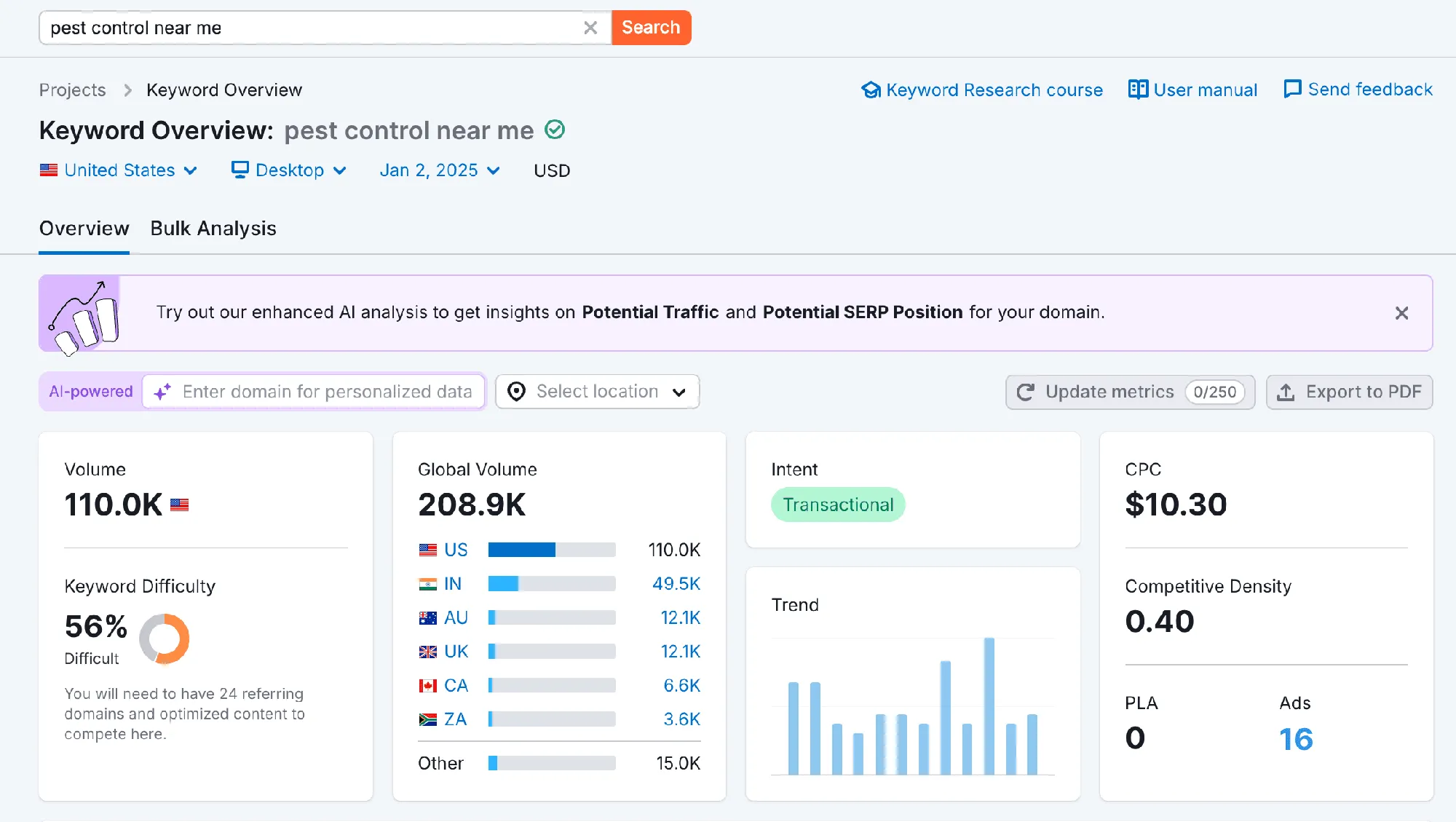
To rank for “pest control near me,” you need a verified Google Business Profile near the searcher, in the right category, with steady reviews and a strong location page behind it. Google ranks these results mostly on distance, relevance and prominence. You can’t change where a homeowner is standing, but you control almost everything else.
Owners ask me how to rank for this keyword all the time. Google spells out most of what decides it, and the rest comes down to a short list of problems I find on most of the profiles I audit.
How Google picks results for “pest control near me”
Google says local results are mainly based on relevance, distance and prominence. Relevance is how well your profile matches the search. Distance is how far your business is from the person searching. Prominence is how well-known you are, and Google says that includes how many websites link to you and how many reviews you have.
“Near me” tells Google to use the searcher’s location. On a phone, Google usually knows exactly where someone is, and if they don’t share it, Google uses what it knows about their location. Most of these searches happen on phones. Go Fish Digital’s pest control keyword data from July 2024 put about 71% of “pest control near me” searches on mobile.
So the same search shows different companies a few miles apart. That’s also why searching from your own office tells you very little. You’re standing next to your own address.
A city search works differently. When someone types “pest control Naperville,” in my experience Google mostly shows profiles located in Naperville, wherever the searcher is. Ranking in towns away from your office is its own project, covered in building local SEO outside your core location.
You can’t fake being close
Distance is the one factor you can’t fix from a laptop. Google measures from your business location, and in my experience that’s true for a service-area business with a hidden address too. The service areas you list tell customers where you’ll go. They don’t move you closer to anyone.
Owners try to get around this with virtual offices, mailboxes, a desk in a co-working space or a friend’s spare room. Google’s guidelines say a virtual office, a mailing address where you don’t actually work, isn’t eligible. P.O. boxes and remote mailboxes aren’t acceptable, and a co-working office needs clear signage and your own staff there during business hours. Video verification asks you to film the location, your equipment and proof you run the business, so a fake address usually fails there or gets suspended later. A suspended profile ranks nowhere.
If you’re a service-area business, Google gives you one profile for the whole area you serve, with up to 20 service areas, and the area shouldn’t stretch past about 2 hours of driving from your base. You’ll rank best near the address you verified, and your reach fades with distance. How far it reaches depends on your competition and the rest of this list.
The honest way to get closer to more homeowners is a real office, staffed, with your sign on the door. If a lot of your best customers live in a town across the county, an office there puts you near them, and it can have its own profile. That’s a growth decision with rent and payroll attached, so make it when the numbers work, not to chase a keyword.
Keep “near me” out of your name and your pages
Some companies add “near me” or a city to their name on Google. Google’s guidelines say the name should be your real-world name, without added service or location information. A profile called “Best Pest Control Near Me Dallas” breaks that rule, competitors report names like it, and it can lose the profile. I don’t do anything that breaks Google’s guidelines for clients, and this is one of the easiest to get caught on.
A real name with “pest control” in it does help with “pest control” searches, and I see that pattern in the scan reports I run. If you’re starting out or rebranding anyway, it’s worth weighing, and I cover how in naming a pest control company. Adding it only on Google isn’t the same thing.
Your website doesn’t need the words “near me” either. Put “Pest Control in Naperville, IL” in the title and H1 of your Naperville page. Google already treats a near-me search as local, so the city does the work. Stuffing “pest control near me” into every heading, or listing every town you serve in a block at the bottom of each page, is keyword stuffing under Google’s spam policies. They give “blocks of text that list cities and regions that a web page is trying to rank for” as an example. The same policies treat near-identical city pages that funnel visitors to one page as doorways.
Your primary category and your reviews
Relevance starts with your primary category. If pest control is your main business, it should be Pest control service. I still find profiles with the wrong primary category, or with a pile of extra categories for work the company doesn’t do. Google says the categories you choose affect your local ranking.
Reviews feed prominence. Google says more reviews and positive ratings can help your local ranking, and they’re what a homeowner reads before calling. I’d aim for about one new review a week on each profile. The pace matters as much as the total. A company that hasn’t gotten a review in months can slip below a smaller competitor that gets one every week.
Ask every customer. Never offer anything for a review, never wait on site while someone writes it and don’t ask only the happy ones. Google’s review policy bans incentives, pressure and selective asking.
If your profile isn’t fully set up, start there. My Google Business Profile guide walks through verifying by video, your name and categories, hours, services, photos, weekly posts and how to ask for reviews.
Link your profile to the page about its city
The website link on your profile is one of the easiest relevance signals you control. Point each profile at the page about its city. For a company with one office, that’s the homepage, built around your home city. Every other office gets its own location page. A page about that city tells Google more about where the profile belongs than a general page can.
A good location page has the city in the title tag and H1, the profile’s name, address and phone number, an embedded map, real photos from jobs in that town, reviews from customers there and details that wouldn’t fit any other city. Put a phone number and short form near the top, because most near-me searchers are on a phone and ready to call.
Two problems show up in a lot of my audits. The homepage ranks for city searches instead of the city page, which usually means the city page is too thin. Or the city pages are copies with the town name swapped, so none of them stands out. If your site can’t support real location pages, that’s where website design comes in.
Keep your details the same everywhere
Your business name, address and phone number should match on your profile, your website, your schema markup and the directories that matter, like Apple Business, Bing Places, Yelp, Facebook and the BBB. Google says businesses with complete and accurate info are more likely to show up in local results, and mismatched details make it harder to tell which version is right.
Tracking numbers cause a lot of the mismatches I find. A CallRail number in your schema that appears nowhere else gives Google two phone numbers for one business, so keep your main number in schema and citations. Old addresses cause the rest, usually after a move. Update the profile first, then the website, then the big directories.
Local Services Ads sit above the map
On a lot of these searches, the first thing a homeowner sees isn’t the map. Local Services Ads often sit above it. In a WebFX study of 100 home service keywords in May 2026, Local Services Ads held the top position every time they appeared, and they showed up in 34% of runs for near-me searches. The study covered HVAC, plumbing, roofing, electrical and garage doors rather than pest control, but it matches what I see.
They’re pay-per-lead, with a Google Verified badge next to your name. Starting in August 2026, Google is moving Local Services Ads into Google Ads as Performance Max campaigns that still charge per lead and still show only on Search and Maps. Mat Rogers told me they’ve also started showing up inside the map pack, and I see it more often now as a sponsored listing on top of the usual three.
Paying for ads won’t lift your map ranking. Google says there’s no way to request or pay for a better local ranking. Under about $500K a year in revenue, I’d put your effort into your profile and Local Services Ads together. My Local Services Ads guide covers setup and the move.
What a map grid shows me
A single rank check means little for a near-me keyword, because the answer changes every few blocks. A map grid scan checks your rank from a grid of points across your area and colors each one, so you can see where you’re in the top three and where you disappear. I explain how to set one up and read it in how to use a 5x5 heatmap for local SEO.
When I run one for an owner asking about near-me rankings, it’s usually green around the office and red a few miles out. Some of that is distance and won’t change. The part you can fix is usually the same short list. The primary category is wrong, the profile links to a page that isn’t about its city, reviews have slowed to a trickle or the phone number doesn’t match across the web.
Searching from your own phone won’t show you any of this. I’ve talked with owners who were sure their profile ranked well because it did when they searched, and the scan showed them outside the top 3 almost everywhere.
Grids do move. Our client SmartGreen Pest Control in Woodstock, GA went from an average map rank of 8.0 to 1.0 on a 7x7 grid, three months later. Moving grids like that is a big part of our pest control SEO work.
Questions pest control owners ask
Should I put “near me” on my website?
Not as a phrase repeated across your pages. Use your service and city in titles, H1s and copy, like “Termite Control in Cary, NC.” Google already treats near-me searches as local and matches them to your location pages and profile.
Why do I rank near my office but not across town?
Mostly distance. Google favors businesses close to the searcher, so your rank fades as you move away from your verified address. Stronger reviews and better location pages stretch your reach. A real second office is the only way to be close in a town far from the first one.
Can I rank for “pest control near me” without an office?
Yes. As a service-area business with a hidden address, you’ll rank around the address you verified, even if it’s your home. Don’t buy a virtual office to get closer to a bigger town. It breaks Google’s guidelines and puts the whole profile at risk.
How long does it take to rank?
Fixes to your category, profile link and hours can show up within weeks. Reviews and location pages take months to build. If you’d like help getting there, book a call.
Get one lesson from the top operators in pest control every Wednesday
A short email from my podcast, Pest Control Legends, when each new episode comes out.
Want more calls from Google?
Book a 30-minute discovery call with Dan to see if we’re a fit.