Blog / Local SEO
Pest Control SEO Tips: 8 Fixes You Can Make This Month

The pest control SEO tips that pay off fastest are fixes to things you already have. Put the city in your title tags, use one H1 per page, link each Google Business Profile to its location page, clean up duplicate URLs, get a review every week and keep your business details identical everywhere.
I find the same problems in most of the pest control SEO audits I run. Most don’t need a new website, and a lot of them take an afternoon. Below is how to check each one and fix it, roughly in the order I’d work through them.
These won’t replace a full pest control SEO plan with city pages, content and links built over months. They do make everything else you do work better.
Fix your titles and headings
Google reads your title tag and your H1 to work out what a page is about and where. They’re also where I find the easiest wins.
Put the city in every title tag
Every money page needs its keyword in the title tag, and for a pest control company that keyword almost always includes a town. “Termite Control | ABC Pest” tells Google nothing about where you work. “Termite Control in Raleigh, NC | ABC Pest Control” does. Put the same keyword in the URL and the H1, and you’ve covered the basics most competitors skip.
To check, run a crawl. Semrush Site Audit and Screaming Frog both list every page’s title, and Search Console shows which queries each page already shows up for.
While you’re there, look at meta descriptions. One description copied across the whole site is one of the most common things I find. It’s the ad copy people read in the results, so write one per page that says what you do, where and why someone should call.
Give every page one H1
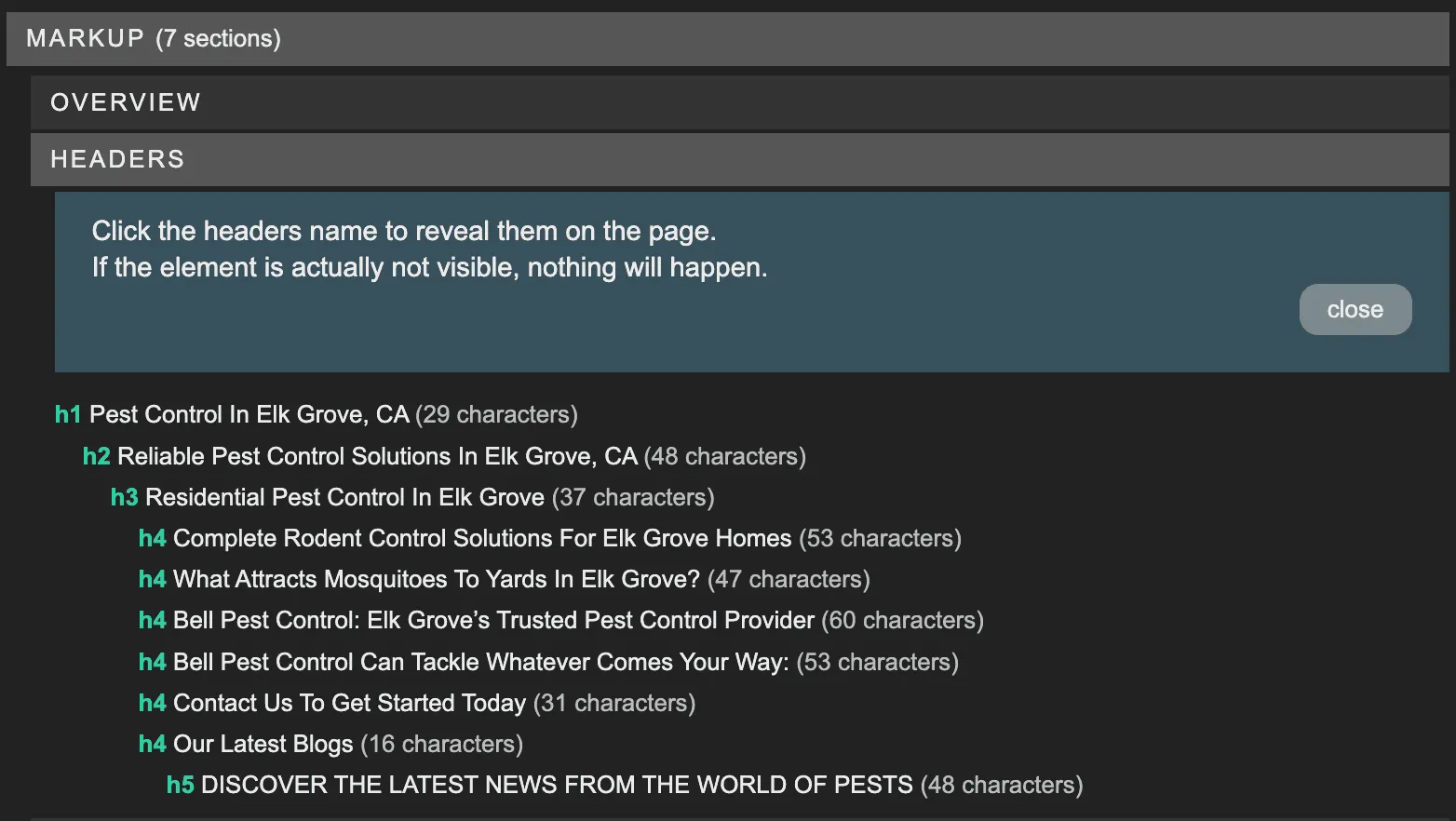
Each page should have one H1 that says what the page is and where, like “Pest Control in Elk Grove, CA,” with H2s and H3s in a logical order under it.
What I usually find is a page with no H1 at all, a page with several, or paragraphs of body text tagged as headings because someone liked how big they looked. In The Complete Guide to Pest Control SEO, I walked through a page ranking for “pest control Glenview” that had five H1s.
To check yours, install the free META SEO Inspector Chrome extension, open a page and look at the headers list. It shows every heading in order, like the screenshot at the top of this post.
Pest control SEO tips for your Google Business Profile
A lot of “near me” calls start on your Google Business Profile, so small fixes here tend to show up quickly.
Link each profile to the page about its city
If you have one Business Profile, link it to your homepage and make the homepage about your home city. With more than one, keep the main office on the homepage and link every other profile to its own city page, so the Naperville profile goes to your Naperville page. The page you link tells Google where that profile belongs. Past about 10 locations, I’d give every profile its own location page, unless your main city is a big one like Chicago that your other towns identify with.
That only works if the location page is good. It needs the city in the title and H1, the profile’s address with an embedded map, real photos from jobs in that city and content that couldn’t be pasted onto another town’s page.
Check categories, hours and the basics
Your primary category should be Pest control service, or Lawn care service if that’s your main business. Add secondary categories only for services you actually provide. Check your hours, including holidays, and fill in your services, opening date and social profile links. Wrong categories and wrong hours show up in my audits more often than you’d expect.
One of our clients, Arete Pest Control in Norcross, GA, got 441 calls from its Google Business Profile in the 4 weeks from Jan 27 to Feb 24, 2025, up 57% from the 4 weeks before, according to CallRail. To see where your profile ranks across your area, run a map grid scan. If you’d rather hand the profile off, that’s what our Google Business Profile service covers.
Make your city pages the ones that rank
Search “pest control” plus your city and see which of your pages comes up. On a lot of the sites I audit, it’s the homepage, even when a city page exists. That usually means the city page is too thin, or too much like your other city pages, for Google to prefer it.
Copy-paste city pages are the usual cause. Same template, new town name, and Google sees a stack of near-identical pages. Its spam policies treat city pages that funnel visitors to one page as doorways. Start with your top few cities and make each page its own, with the pests you see there, the neighborhoods, a photo of your truck in that town, reviews from customers there and an FAQ about the area. Put your phone number and a short form near the top.
Then point links at them. Your menu, service pages and blog posts should link to city pages, with the city in the anchor text. Every blog post should link to at least one service or city page. Posts with no links out and nothing linking in are some of the most common pages I find in audits. My guide to pest control blog ideas shows how each type of post links back to these pages.
Make sure Google sees one version of each page
Type your domain four ways: http and https, with and without www. All four should end up on the same version through a permanent (301) redirect. On plenty of pest control sites, both www and non-www load on their own, which splits your links between two copies. Google’s guidance on duplicate URLs is to pick one URL as canonical and redirect the others to it.
Next, type a made-up address, like yoursite.com/this-page-does-not-exist. You should get a 404 page. If your homepage loads instead, every broken link and typo becomes another copy of your homepage for Google to sort through.
After a redesign or a move to a new platform, look for leftovers like old service pages, a /home page, test pages and copies ending in -2. Redirect each one to its closest match on the new site. The Pages report in Search Console shows which URLs Google indexed and why it skipped the rest. Submit your XML sitemap there too.
Last, open yoursite.com/robots.txt. If you see “Disallow: /” under “User-agent: *”, your site is telling search engines not to crawl anything. That setting is meant for sites that are still being built, and sometimes nobody turns it off.
Get a review every week
Google says plainly that reviews count. Its help page on local ranking says more reviews and positive ratings can help a business rank. The total and the star rating matter, but so does a steady pace. I once saw a company with about 150 reviews beating one with 1,000, because the bigger company hadn’t gotten a new review in about six months while the smaller one was getting two or three a week.
For most companies, I’d aim for about one review a week on each profile, and more once you have several techs on the road. Mat Rogers made the case on my show that steady review velocity beats one big push followed by silence.
The simplest system is asking in person after a good service, with your review link on a QR code the tech can show on a phone or card, then following up by text. Once you have a team, software like Applause helps. Its co-founder, Chris Anderson, told me great reviews start with your technicians.
Stay inside Google’s rules. Its review policy doesn’t allow offering discounts, free services or anything else in exchange for a review, asking only your happy customers or pressuring people to leave one while you’re on site. Reply to every review, good or bad.
Keep your business details the same everywhere
Your business name, address and phone number should match exactly on your website, Google Business Profile, social profiles and every directory. Small mismatches add up.
Tracking numbers cause a lot of these mismatches. Call tracking is worth having, and CallRail can swap in a tracking number for website visitors, but your schema markup and directory listings should show the same main number as your Google Business Profile. A number in your schema that appears nowhere else sends Google mixed signals.
Outdated schema causes the rest. Plenty of pest control sites carry LocalBusiness schema with an old address, an old phone number or the wrong hours. Test your homepage and location pages in the Schema Markup Validator and fix anything that doesn’t match your profile.
Citations matter less than they used to, but the main ones still need to be right: Apple Business (formerly Apple Business Connect), Bing Places, Yelp, Facebook, Nextdoor, Angi and the BBB. A listing tool like Semrush’s listing management or BrightLocal can push the same details to the data aggregators and smaller directories, so you aren’t fixing each one by hand.
Make the site fast
A lot of people searching for an exterminator are on a phone with the problem right in front of them, and a slow page loses them. Run your city and service pages through PageSpeed Insights on mobile, then check the Core Web Vitals report in Search Console, which is based on real visitors.
The slow sites I see are usually built on a heavy page builder with a pile of plugins, uncompressed images and sliders that add nothing. Remove plugins you don’t use, compress your images and keep the top of each page simple. Good hosting and a CDN like Cloudflare help. Whatever’s left needs regular updates to stay fast and secure, which is a big part of website maintenance.
While you’re working on images, add alt text that describes what’s in each one, like “technician inspecting a crawl space for termites in Cary, NC.” Missing alt text shows up in a lot of my audits.
Sometimes the honest answer is a new site. After we built Invicta Pest Control a new website in Raleigh, NC, organic clicks went to 3.4x the same months the year before, according to Search Console. If yours is slow and hard to update, a pest control website built for search may get you further than patching it.
Earn local links, not directory spam
Links from other sites still separate the companies that rank from the ones that don’t. On that same local ranking page, Google says prominence is also based on how many websites link to your business and how many reviews you have.
A lot of the backlink profiles I review are weak, padded with spammy directory links that don’t help. Local links are worth more, and they’re easier to get than most owners think:
- Join your chamber of commerce. Most chambers list members on their site with a link.
- Sponsor a youth team, a 5K or a school fundraiser, and ask whether sponsors get a link on the event or team page.
- Build relationships with home inspectors and realtors. You already work their deals on termite inspections, and a link from their recommended vendors page is a real local endorsement.
- Work with adjacent businesses like lawn care, HVAC and roofing companies. Link to them first, then ask if you can leave a testimonial on their site that links back.
A link from your town’s chamber does more for a local pest control company than a pile of directory links from sites nobody visits. Semrush’s Backlink Analytics shows what you’ve earned.
Questions pest control owners ask
How long do these SEO fixes take to work?
Redirects, titles, headings and the profile link can show up within weeks, once Google recrawls the pages. Requesting indexing with the URL Inspection tool in Search Console can speed that up. Reviews and links build over months.
Can I make these changes myself?
Most of them, yes. Your profile link, categories, hours, review routine and chamber membership need no code. Redirects, robots.txt, schema and speed usually need whoever manages your site. If you want an expert to look first, my SEO consulting is a paid hour for owners who’d rather do the work themselves.
Do pest control companies still need SEO with AI Overviews?
Yes. AI Overviews pull from pages Google already trusts. Aaron Shishilla told me a post his team wrote ranked number one for “how to get rid of ants” for a year, and now an AI Overview sits above it, citing the site as a source. The fixes in this post help with both.
What should I fix first?
Start with anything that blocks Google outright, like a robots.txt that disallows crawling or both www and non-www loading. Then fix your profile links and categories, then titles and H1s. Start the weekly review routine right away, since it takes longest to build. If you’d rather have us make the fixes, book a call. I talk to every client myself.
Want more calls from Google?
Book a 30-minute discovery call with Dan to see if we’re a fit.