Blog / Artificial Intelligence
Pest Control AI Search: How to Show Up in ChatGPT and Google's AI Answers

Pest control AI search runs on facts that already exist about your company. ChatGPT, Gemini, Google’s AI Overviews and AI Mode build their answers from your Google Business Profile, your reviews, your website, Bing’s index and what other sites say about you. Make those complete and consistent, and you give them a reason to name you.
When owners ask me about AI, it’s usually one of two questions. How do I show up in ChatGPT, and can I just pay to be there? This post answers both, then covers what AI is actually good for in your marketing and where it goes wrong.
How AI assistants pick a pest control company
When a homeowner asks an assistant who to call about mice, it doesn’t have a private list of exterminators. It looks your company up, much like a person would, and summarizes what it finds. Each one looks in different places.
| Assistant | Where it looks | What to get right first |
|---|---|---|
| Google AI Overviews, AI Mode and Gemini | Your Business Profile, reviews, website and other sites | Business Profile and reviews |
| ChatGPT | Mostly Bing’s index, business websites and Google reviews | Your website and Bing listing |
| Apple Maps | Your Apple Maps listing | Your Apple Business listing |
On Google, Whitespark’s guide to AI Mode for local businesses found its summaries pull ratings, review counts, pricing and hours from Business Profiles and other sources, with reviews as one of the main things it returns. It also cites Sterling Sky’s finding that these AI local packs often show fewer than three businesses. Google keeps changing the Business Profile itself, too, which I covered in pest control marketing trends for 2027.
ChatGPT works differently. BrightLocal ran 800 ChatGPT searches across 20 industries and 20 US cities in late 2024, and business websites made up 58% of the sources it cited, with mentions on other sites at 27% and directories at 15%. BrightLocal also says ChatGPT search is mostly powered by Bing’s index and uses Google review information for local results. That study is almost two years old, but your website and Bing listing are still in your hands.
Fix your listings on Google, Bing and Apple
Start with your Google Business Profile, since it feeds Google’s map pack, its AI answers and your Local Services Ads. Pick the right primary category, keep your hours honest, fill in your services, add real photos from jobs, link the profile to its matching location page and post once a week. My Google Business Profile guide walks through every field.
Then claim the two listings most owners skip.
- Bing Places for Business. If ChatGPT leans on Bing, a missing or outdated Bing listing costs you more than it used to.
- Apple Business. The old Apple Business Connect address now sends you to Apple Business, where you claim your location on Apple Maps and control your logo, hours, images and key details.
Use the same business name, address, phone number and hours on all three, on your website and on every directory. Inconsistent details are one of the most common problems I find in audits, and they hand an AI tool conflicting facts to choose from. Watch for tracking numbers that end up in your website’s schema or in directory listings, too.
Never use a fake address, a virtual office or a business name stuffed with keywords. Those break Google’s guidelines, and a suspended profile takes you out of the map pack and Google’s AI answers along with it.
Reviews are what AI reads about you
Reviews are where an assistant learns what you do, where you do it and how customers feel afterward. A review that says “they sealed up the mice in our garage in Apex” tells it a lot more than “great service.” You can’t write a customer’s review for them, but asking right after a job, while the details are fresh, gets you more specific ones.
Aim for about one new review a week on each profile. Mat Rogers of Lizard Marketing told me AI is looking for experience, expertise, authority and trust, and that a slower, steady pace of reviews builds that trust better than a burst followed by silence (Mat’s episode on AI and E-E-A-T).
Google reviews come first, but don’t stop there. Chris Anderson’s software, Applause, asks for a Google review and then rotates customers through Facebook, Nextdoor and the BBB. As an SEO guy, I loved that. Google prefers its own reviews, but ChatGPT, Perplexity and other AI tools pull from everywhere.
Stay inside the rules on every platform. Google’s review policy bans offering anything in exchange for a review, asking only the customers you know are happy and pressuring people to write one while you’re on site. Ask everyone, and let them write it on their own time.
Write pages an AI can quote
An assistant can only repeat what’s written somewhere. If your website never says you treat bed bugs in Cary, don’t expect ChatGPT to say it for you.
Give each service and each town you serve its own page, written about that service or that town. A copy-paste city page with the town name swapped gives an assistant nothing that sets you apart. On each page, answer the questions homeowners ask before they call, plainly and near the top. Say which pests you treat, which towns you cover, how soon you can come out, whether you offer one-time or recurring service, what affects the price and what your guarantee covers.
When I asked Mat Rogers how to show up in ChatGPT and the other AI tools, his answer was content. He wants shorter paragraphs, FAQs and answers built around what people actually search, and he thinks hyperlocal detail has the biggest impact. His example was a mosquito post that mentions Main Street and the shops in his small town (Mat on hyperlocal content). He also links that content to the client’s Business Profile and keeps the profile updated with it, which he says helps Gemini reference what you publish.
When he came back for a second episode, Mat told me this gives smaller companies a real opening against the national brands.
“All of a sudden, you can be on page 10, but your voice starts showing up because you’re doing the right things.”
Mentions on other websites count too. A chamber of commerce listing, a team you sponsor, a home inspector’s vendor list or a story in the local paper tells an assistant that people in your town know you. Spammy directory links don’t.
How to check where you stand
Ask the assistants yourself. It takes about an hour and shows you what a homeowner sees.
- Write down 5 to 10 questions a homeowner in your area would ask. “Who’s the best pest control company in Cary, NC?” “Who can get rid of bed bugs in Cary this week?” Add one with your company’s name, like “Is [your company] any good?”
- Ask each one in ChatGPT, Gemini and Google’s AI Mode, in a private window. Whitespark points out that each AI Mode user may see different results, so ask more than once, on a phone and a computer.
- Write down whether you were named, who was, which sources it cited and anything it got wrong about you, like old hours or a service you dropped.
- Ask the assistant where it got its answer, which Mat suggested for Google’s AI answers. Then fix the source, whether that’s an old Yelp listing, a directory with your previous address or a service page that never names the town.
- Run the same questions every few months and compare.
Add “ChatGPT or another AI tool” as an option in the lead source field of FieldRoutes, PestPac or whatever CRM you use, and have the office ask how every new customer heard about you.
Two things I like to tell owners about AI answers. First, Google’s AI is pulling from Google reviews more than it used to. Google Maps has started testing Ask Maps, where Gemini answers questions about a business and leans on its reviews to do it. Reviews don’t need to be stuffed with keywords, but they do need to talk about the work. If more of your reviews mention bed bugs than anyone else’s in your area, you’ll likely show up at the top when someone asks Maps about bed bugs. So ask every customer, bed bug jobs included, and let them describe what you did in their own words.
Second, reviews on other sites count. We’ve found that companies with a lot of reviews on Yelp, Facebook and other platforms do better across the AI tools. My partner Jake Sheldon saw it with one of his own companies. It had a lot of Facebook reviews, and that’s why it was doing so well in AI answers.
Can you advertise in ChatGPT?
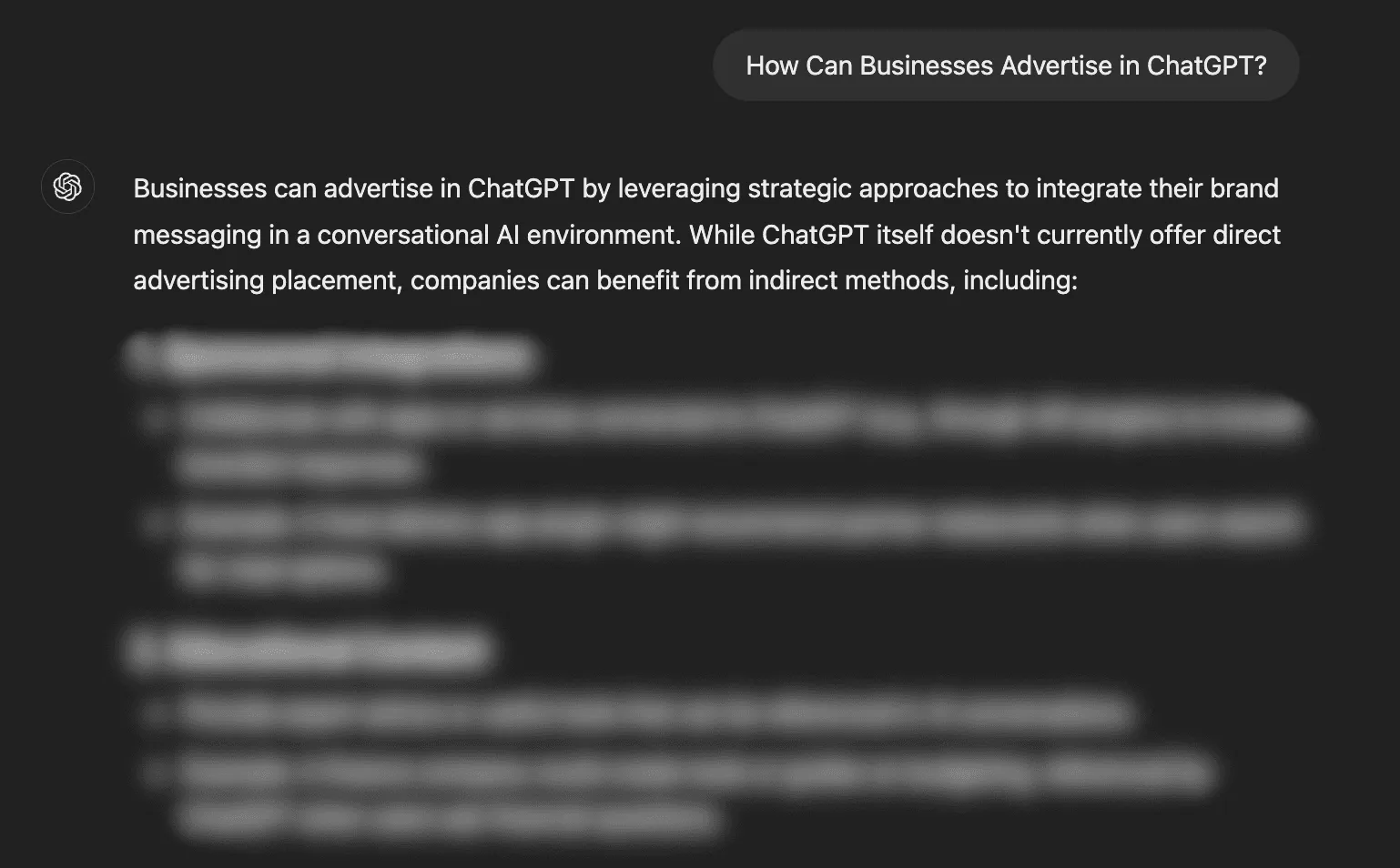
Yes, as of 2026. The screenshot at the top of this post is from 2024, when ChatGPT told people it didn’t offer advertising.
OpenAI started testing ads in the US on February 9, 2026. According to its help page on ads in ChatGPT, ads can appear below a response and are labeled as sponsored. Only Free and Go users see them, so Plus, Pro, Business, Enterprise and Edu accounts don’t. OpenAI says ads don’t influence ChatGPT’s answers, and advertisers can’t shape them.
In May 2026, OpenAI started rolling out a self-serve Ads Manager to US advertisers as a beta and dropped the $50,000 minimum advertisers had needed to test campaigns, Axios reported. You can pay per click, and OpenAI recommends a starting maximum bid of $3 to $5 a click, according to PPC Land. Ads aren’t matched to exact keywords the way Google’s are. You describe the kinds of conversations you want with “context hints,” and nothing I read described a way to target by town or zip code.
For a local pest control company, I’d wait. An ad can’t buy you a mention in the answer itself, so your ad might sit underneath a reply that recommends your competitor. Google Ads and Local Services Ads already reach people searching in the towns your trucks cover. Once those are profitable and tracked, a small ChatGPT test with its own tracking number won’t hurt.
Google’s AI answers already carry ads, and you may be in them without knowing it. Google started showing Search and Shopping ads inside AI Overviews on desktop in the US in May 2025, and campaigns using broad match, AI Max or Performance Max became eligible automatically. In September 2026, Google confirmed a small test that lets exact and phrase match keywords show text ads in AI Mode when the searcher’s intent is explicit. Google Ads still doesn’t report AI Mode separately, PPC Land noted, so you can’t see which clicks came from an AI answer. My guide to Google Ads for pest control covers the setup, or our Google Ads service can run it.
What pest control AI tools are good for
Search “pest control AI” and most of what comes up is about operations, like routing, scheduling, identifying pests from photos and answering the phone. For marketing, AI earns its keep on first drafts, as long as the facts come from you.
- Blog posts and page copy. Record yourself explaining a topic to a new tech, then have ChatGPT turn the transcript into a draft. Tell it who you are, where you work and who the post is for before you paste anything. My guide to pest control blog ideas covers the topics.
- Review replies. Paste in a review and ask for a reply that mentions the specific job. Edit it so it sounds like you, and never paste the same reply on every review.
- Ad copy ideas. Ask for a batch of Google Ads headlines for termite inspections in one town, then cut anything you don’t actually offer.
- Meta descriptions and Business Profile posts. I often find one meta description copied across a whole site. AI can draft a unique one per page in minutes.
Mat Rogers has fed ChatGPT so much of his own material that it sounds like him, and he uses Gemini for paid search. He told me SEO work that used to take his team hours each month now takes a fraction of the time, while they keep their own hands on the schema.
Where AI goes wrong
I learned this one myself. When I turned my pest control SEO course into a book in early 2025, my plan was to feed each section into ChatGPT and let it write the book. Version after version came back bad. What worked in the end was the course I’d written myself, which was already long enough to be a book. AI can tidy up what you know, but it can’t know it for you.
In pest control marketing, it goes wrong in a few predictable ways.
- Generic pages. AI makes it cheap to publish dozens of city pages that all say the same thing. Those pages were already one of the most common problems I found in audits before AI, and more of them doesn’t help.
- Invented facts. Ask AI for an About page and it will happily write that you’ve been family-owned for generations, use only pet-safe products and guarantee results by tomorrow. If any of that is wrong, assistants can end up quoting it back to homeowners. Someone who knows the business has to check every claim.
- Fake photos. AI images of technicians and trucks look generic. Real job photos, with the flash on, build more trust.
- One voice for everything. When every review reply and social caption sounds the same, customers notice.
Questions pest control owners ask
Will ChatGPT replace Google for finding a pest control company?
Not soon. Far more people ask AI tools for local recommendations than a year ago, but in BrightLocal’s 2026 survey, Google and Facebook still ranked ahead of AI. Google’s own AI answers draw on your Business Profile anyway.
Can I pay to have ChatGPT recommend my company?
No. ChatGPT ads show below the answer, and OpenAI says they don’t influence what it recommends. Be careful with anyone who promises you a spot in ChatGPT’s answers.
Do I need a separate “AI SEO” agency?
Mostly, it’s the same work as local SEO. A strong profile, steady reviews, real service and city pages, consistent details and mentions from local sites cover most of what AI tools look at. If your pest control SEO is done well, you’re already doing it.
What should a smaller pest control company do first?
Under about $500K a year in revenue, put your effort into your Google Business Profile and Local Services Ads. Your profile feeds Google’s AI answers too. Past that, invest in your website and SEO. If you’d like help figuring out where you stand, book a call.
Want more calls from Google?
Book a 30-minute discovery call with Dan to see if we’re a fit.