Blog / Marketing
SEO vs LSA vs Google Ads: Where Pest Control Companies Should Spend First

SEO vs LSA vs Google Ads comes down to your size. Under about $500K a year, put your effort into your Google Business Profile and Local Services Ads. Past that, add Google Ads, then put real money into your website and SEO. Most pest control companies end up with all three, since each holds its own spot on the page.
Owners ask me some version of this all the time. They have money for one more thing and want to know which one gets it. This post compares the three, shows how they feed each other and covers how to tell which one is paying.
Local pack, organic results and ads on one search
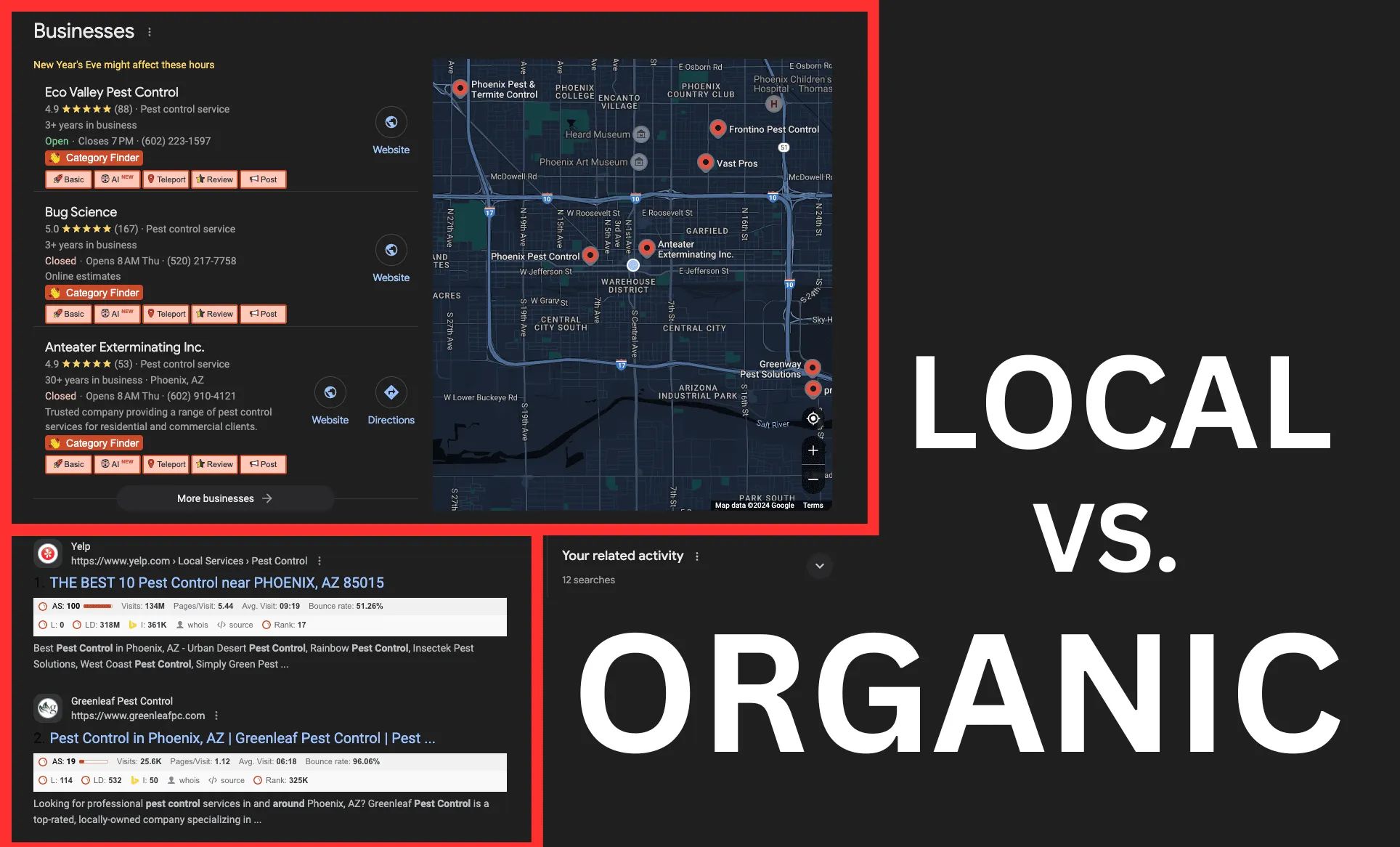
Search “pest control” plus your town on your phone, and you’ll usually see results stacked in layers.
- Local Services Ads, often at the very top, with a Google Verified badge. You pay per lead.
- Google search ads. You pay per click.
- The map pack, also called the local pack, with three Google Business Profiles and a map. It’s free.
- Organic results, the regular website listings below that. Your site competes there with Yelp, Angi and other directories. It’s free too.
The image at the top of this post is a Phoenix search, with the map pack outlined at the top and Yelp and a local pest control company below it in the organic results.
SEO covers the two free spots, and the two kinds of ads cover the rest. The order on the page changes from search to search, and lately I see Local Services Ads inside the map pack too, as a fourth listing marked “Sponsored” in small letters. Mat Rogers of Lizard Marketing thinks LSAs will slowly replace pay-per-click, and his agency is trying to move client budgets that way.
SEO vs LSA vs Google Ads side by side
| SEO | Local Services Ads | Google Ads | |
|---|---|---|---|
| How you pay | Your time or an agency’s fee, never per click or call | Per valid lead, like calls, messages and booking requests | Per click on your ad |
| How fast it works | Months. From a weak start, it can take 6 or more before you see real results | Leads can start once Google verifies you, which takes 3 to 4 weeks on average | As soon as your ads are approved |
| What happens when you stop | Rankings hold for a while and slip as competitors keep working. The profile, reviews and pages stay yours | Leads stop that day | Clicks stop that day |
| Who it suits | Every company for the Business Profile. Real website investment past about $500K a year | Licensed, insured companies under about $500K, and almost everyone above | Companies past about $500K that want control over keywords, towns and landing pages |
The verification time comes from Google’s screening requirements, and the SEO timeline from what I’ve seen with companies that start from very little.
SEO isn’t free. You pay in time or fees instead of per call, and you wait. In exchange, it gets cheaper per lead the longer it works, and it doesn’t vanish when a bill goes unpaid. EcoCare Pest Control in Portland, Oregon saw qualified SEO calls go up 216% in the first 6 months (CallRail). Both kinds of ads bring calls much faster, but those calls stop when the budget does.
How your Google Business Profile fits into SEO
SEO means showing up in search without paying for the spot. For a pest control company, that work has two halves, and owners mix them up all the time.
Local SEO happens on your Business Profile
Your Google Business Profile is a listing Google owns, a bit like a Yelp page that appears right inside Search and Maps. It’s what shows up in the map pack. Google says it ranks those results on relevance, distance and prominence, and that prominence draws on things like how many websites link to you and how many reviews you have. You can’t do much about distance, so relevance and prominence are where the work goes.
A profile is the easier half to run yourself. Pick the right categories, set real hours, add real photos, post once a week and keep reviews coming. You can’t customize much beyond that, which is also why it’s quick to get right. My full Google Business Profile guide goes through every setting.
Organic SEO happens on your website
Organic results are the regular listings below the map, and your website does that work. It needs a page for each service and each town you want calls from, and it can hold things a profile can’t, like long service pages, city pages, a blog and forms. A post on preventing termites can rank organically for homeowners asking questions, while your profile ranks in the map pack for “pest control near me.”
A website takes more skill to build and keep fast, and most owners are better off handing it to someone who builds sites every day.
The two halves lean on each other. Link each profile to the page about its city, so the page backs up the profile. One problem I find on a lot of audits is the homepage ranking for every city search because the city pages are thin copies of each other. Together, the profile and the website are what I mean by pest control SEO.
Pay per lead or pay per click
Local Services Ads and Google Ads are both paid, but they charge differently and give you very different amounts of control.
Local Services Ads charge for valid leads. You choose your services and service area, and Google decides which searches you show for. Your reviews and how fast you answer the phone decide a lot of how often you show. There’s little to manage, which is why most owners can run them on their own. My Local Services Ads guide covers verification, lead disputes and ranking.
Google search ads charge for every click, whether that person calls or not. You pick the keywords, write the ads, set the towns and choose the page each click lands on. That’s more control, and more ways to waste money. When I open a pest control ad account, I usually find ads showing far outside the service area, clicks landing on the homepage or campaigns nobody has touched in months. I cover the setup in my guide to Google Ads for pest control.
The line between them is blurring. Starting in August 2026, Google began moving Local Services Ads into Google Ads as Performance Max campaigns built for pay-per-lead, per Search Engine Journal. They’ll sit in the same account, but they still charge per lead and still run without keywords.
Where to spend first at your size
Under about $500K a year
Put your effort into your Google Business Profile and Local Services Ads. The profile costs nothing but time, LSA only charges for leads, and an owner who isn’t technical can run both. Both lean on reviews, so ask every customer and aim for about one new review a week per profile.
Keep a website that loads fast on a phone and lists your services and towns, but hold off on paying for a big SEO push. I’d rather tell a smaller company to wait on SEO than sell it something that won’t pay off in time. When I wrote The Complete Guide to Pest Control SEO in early 2025, I put this line at $1 million. I’ve since moved it down to about $500K.
Past about $500K a year
Start Google Ads on the services worth the most to you, especially in towns where your Local Services Ads rarely show. Then put real money into the website and SEO, with city pages written for each town, service pages, local links and the technical basics. Keep LSA running. Adding a channel doesn’t mean cutting one.
If cash is tight at either stage, Aaron Shishilla of WolfPack Advising told me he’d spend on the bottom-of-funnel work, where the return is easiest to see. For most pest control companies, that means Google before brand channels like radio or billboards.
The full setup order, including social media and email, is in digital marketing for pest control. If you’re weighing Facebook, Yelp, direct mail or radio, I compare those in pest control advertising.
How the three work together
They share parts, so each one makes the others cheaper or stronger.
Your Business Profile feeds your Local Services Ads. Google requires a verified profile to advertise, and in the new Google Ads setup your name, address and hours sync straight from it. Reviews do double duty, helping you in the map pack and in the LSA row.
Your website does the same job for Google Ads. Every ad sends people to a page, and a fast page about exactly what they searched for turns more clicks into calls. Mat Rogers described Google’s AI Max campaigns as paid SEO, because page quality and site structure now count toward ad performance.
It runs the other way too. The search terms report in Google Ads shows which searches turn into calls in each town, and those are the city and service pages worth building for SEO.
Showing up more than once also builds trust. A homeowner who sees you in the LSA row, again in the map pack and again in the organic results has three chances to pick you. Our services page shows how we handle the SEO, Business Profile and Google Ads pieces.
You can’t judge them without call tracking
Without call tracking, a call from Google Ads looks exactly like one from the map pack, and every argument about which channel works turns into a guess. I told Aaron on his episode that tracking is non-negotiable once you’re on several platforms. If one channel barely makes money while another crushes it, you need to know so you can move the budget.
Give each channel its own number, set the lead source on every new customer in FieldRoutes or PestPac, and compare what a customer costs from each one, not what a lead costs. When Arete Pest Control in Norcross, Georgia saw Google Business Profile calls go up 57%, with 441 calls in the 4 weeks from January 27 to February 24, 2025, compared with the 4 weeks before, we could see it because the profile had its own CallRail number.
This is often where owners find out what they’re really paying for. I’ve seen several companies working with an SEO agency set up call tracking properly and learn that their calls come from their Business Profiles and from people searching their name, while the website brings in nothing from SEO on its own.
How to set up the numbers, and what a monthly report should show, is in my guide to pest control call tracking.
Questions pest control owners ask
Is SEO better than Google Ads for pest control?
Neither wins on its own. Google Ads bring calls this week and stop when you stop paying. SEO takes months and keeps working. Past about $500K a year, most companies should run both.
What’s the difference between local SEO and organic SEO?
Local SEO is about the map pack and Google Maps, and it runs on your Business Profile, reviews and distance. Organic SEO is about the website listings below the map. A pest control company needs both, and each helps the other.
Is a Google Business Profile the same thing as SEO?
No. Your profile is one of the things SEO works on. A strong profile with a weak website limits how far you can grow, and a good website with a neglected profile misses a lot of “near me” searches.
Do I still need SEO if my Local Services Ads are working?
Eventually, yes. LSA leads stop the day the budget does, and costs have climbed as more companies run them. Google also says there’s no way to pay for a better local ranking, so the map pack still has to be earned. If you want help deciding where your next dollar goes, book a call.
Want more calls from Google?
Book a 30-minute discovery call with Dan to see if we’re a fit.