Blog / Marketing
Local Services Ads for Pest Control: The Complete Guide

Local Services Ads for pest control are Google’s pay-per-lead ads, shown with a Google Verified badge at the top of many local searches. You pass Google’s license, insurance and background checks, choose the services you want leads for, and pay for valid calls, messages and bookings instead of clicks. Reviews and answering the phone decide most of the rest.
Google changed the badge last fall and is now moving Local Services Ads into Google Ads, so a lot of older advice on pest control local service ads is out of date. This guide covers how it works for a pest control company in October 2026.
Where Local Services Ads for pest control show up
Search “pest control” plus your town on your phone, and a row of Local Services Ads is often the first thing you see. Each one shows the company name, star rating, phone number and hours. Tap one and you get a profile with your services, service area, license details and reviews.
They run on Google Search and Google Maps. Lately I’ve also been seeing them inside the map pack, as a fourth listing above the usual three with “Sponsored” in small letters.
Your ads are separate from your Google Business Profile, but they lean on it. Google requires a public, verified Business Profile before you can advertise.
When pest control companies first got access, these ads were cheap and almost nobody ran them. Eric Bassett of Natura Pest Control told me his marketing company back then wanted him to sign up early. He wasn’t sure the background check was worth the trouble, but for a while Natura got a lot of high-quality, low-cost leads until everybody else caught on. Far more companies run them now, so leads cost more and the bar on reviews is higher.
Getting the Google Verified badge
Owners still ask me how to get Google Guaranteed for their pest control company. That program is gone. Starting in October 2025, Google folded Google Guaranteed, Google Screened, License Verified by Google and the money back guarantee into one Google Verified badge, according to Search Engine Land.
The badge appears on profiles that have finished Google’s screening and verification, and it shows which checks the business passed, like licensing and background checks. If your website still talks about being Google Guaranteed, update it.
What Google checks for pest control
Google’s screening and verification requirements list these for pest control in the US:
- A public, verified Google Business Profile
- A background check on the business and on the owner (Google marks both “select users only”)
- A business representative check, also for select users
- General liability and professional liability insurance
- A state-level business license and owner license, where your state requires them
Pest control doesn’t come with a check on each technician. Google lists that kind of screening for some other trades, like locksmiths, garage door companies and HVAC.
Google says verification takes 3 to 4 weeks on average after you submit your documents. Before you start, make sure your business name, license and insurance all match each other and your profile. Mismatches are policy problems, and those can lead to suspensions and fewer leads.
Business categories for pest control, lawn care and wildlife companies
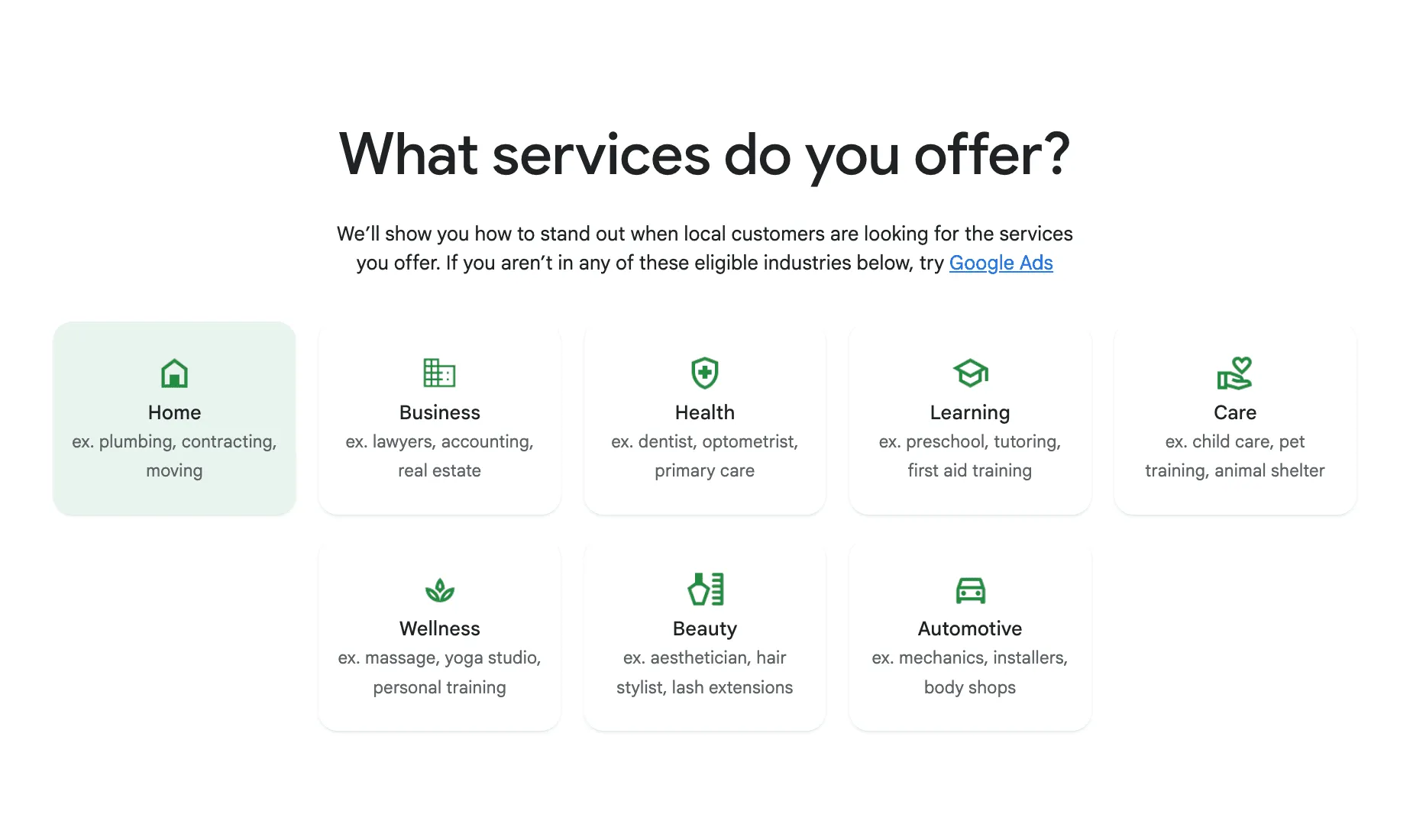
Local Services Ads reach well past home services now. Google’s requirements page lists groups like auto care, beauty, health care, pet care, professional services and wellness, and the screenshot at the top of this post shows the sign-up asking what services you offer.
For the companies I work with, four categories matter.
| Category | How Google describes it | Checks and paperwork |
|---|---|---|
| Pest control | Inspecting and removing pests, including bugs and rodents | Business and owner background checks, liability insurance, state licenses where required |
| Lawn care | Lawn installation and maintenance, like weed control, mowing and seeding | Same as pest control |
| Landscaping services | Designing, installing and maintaining gardens and landscapes | Same as pest control |
| Tree service | Planting, removing and maintaining trees | Same as pest control |
There’s no wildlife removal or animal control category. Animal rescue, listed under pet care, is meant for groups that rescue and rehabilitate animals, not for getting raccoons out of an attic. Google describes the pest control category as removing bugs and rodents. A wildlife company that also does rodent work can use it, with only the services it really offers turned on, as long as its licenses meet Google’s pest control checks for its state. A wildlife-only company will usually get more from Google Ads and its Business Profile, where “Animal control service” is a category, than from Local Services Ads.
If you do pest control and lawn care, you can advertise in both.
How Google charges per lead
You pay for valid leads, not clicks. Google’s page on lead charges counts these as leads:
- Answered calls, including ones you return and connect on
- Missed calls, if the caller stays on the line more than 20 seconds during your business hours
- Voicemails
- Texts and emails
- Booking requests, in the US and Canada
Message leads usually cost less than calls, though not always, since Google prices each lead by how likely that customer is to book.
Some contacts aren’t charged. Google filters out spam and duplicates. A caller who hangs up at your phone menu without pressing a key costs nothing, and the same number or email reaching you again within 15 days of your last interaction doesn’t count as a new lead.
What a lead costs depends on your market, the service and how many companies compete for it. Tony Carder of TruNorth Pest Control told me an LSA lead runs around $100, next to about 4 cents for one of his door hangers.
Disputing a bad lead
Google keeps assessing charged leads for 30 days and may credit low-quality ones on its own. If a lead was junk, say why in the feedback survey for that lead. Google says it may occasionally credit leads you report, so don’t count on it. The Leads page shows each lead as Charged, Not charged, In review or Credited.
When a caller is outside your area, tell them plainly on the call, like “You’re in Lake Forest? We only cover Chicago.” Then note it in the survey. If you keep getting leads you don’t want, tighten your service areas, categories and service types.
What decides how many leads you get
Google’s page on how Local Services Ads rank starts with your bid and how likely your ad is to produce a lead. Under that, it lists your responsiveness, the search itself (the service, the time and the location), how well your services and bio match, and the quality of your profile, meaning your rating, number of reviews, response time, photos and completed checks. You control most of that list.
Reviews
In my experience, reviews matter most, both for where you show and for whether people tap you. Look at how many reviews the top ads in your town have, and work to pass them. Aim for about one new review a week per profile.
Ask every customer. Never offer anything for a review, don’t stand there while someone writes one, and don’t ask only the happy ones. Google’s review policy bans incentives and pressure.
Photos help too. Most companies skip them. Real pictures of your techs and trucks tell a homeowner who’s about to show up at the door.
Answering the phone
Google says missed calls can hurt your responsiveness. A missed call during business hours can also be charged if the caller waited more than 20 seconds, so you pay for the lead and get shown less afterward.
When an owner tells me they get no leads from Local Services Ads, this is one of the first things I check. I’ve talked to owners who were getting nothing because they never answered the phone, and it’s more common than you’d think.
Hours
Set your business hours to when someone really answers. Google says turning on message and booking leads gives customers more ways to reach you, especially at night and on weekends.
Budget
A budget that runs dry by lunch takes you out of the results for the rest of the day. Watch it in the busy season, when more homeowners are searching.
Service area
You only show in the areas you’ve chosen, and the searcher’s location is part of the ranking. Cover the zip codes or towns your trucks really reach. If several of your locations serve the same area, Google shows only the highest-ranking one for that search.
Which services to turn on
Inside the pest control category, you choose the services you want leads for. Turn on only what you sell, in places you’d actually drive to.
Some owners keep only their higher-value services on so the cost per lead makes sense. Think about lifetime value before you cut general pest, though. Breaking even on the first service can still pay off with a recurring customer who stays for years.
Once your account moves into Google Ads, one target cost per lead covers every category in a campaign, so a different target for lawn care than for pest control means a separate campaign.
Booking and marking leads
Most owners can run Local Services Ads themselves. Once you’re verified, the main ongoing job is working your leads.
In the lead inbox, open a lead, choose Mark Booked, and set the job date or mark it completed. You can add the job type and customer name, which only you can see. That’s available in the US and Canada, and Google’s reports then show how many of your leads became bookings.
If you turn on bookings, homeowners can send a booking request instead of calling, and Google counts it as a lead.
Then record the outcome in FieldRoutes, PestPac or whatever CRM you use, with Local Services Ads as the lead source. That’s how you find out which LSA leads became customers who stayed. I cover the setup in call tracking for pest control.
If you already work with us, we’re happy to handle the LSA side for you. If it’s all you need, I’ll usually tell you to run it yourself.
Local Services Ads are moving into Google Ads
In August 2026, Google started moving Local Services Ads into Google Ads as Performance Max campaigns built for pay-per-lead, according to Search Engine Journal. It began with a limited group of US advertisers, and other accounts follow through 2027.
You still pay per valid lead, and the ads still run without keywords on Search and Maps. What changes is where you manage them, along with how budgets and bidding work. Your name, address and hours also sync from your Business Profile, so don’t make a big change there without thinking it through.
When Google’s notice arrives, download your performance reports, because historical reports don’t carry over. I walk through the rest of the switch, and what to check afterward, in my guide to Google Ads for pest control.
Start here if you’re under about $500K a year
If your company does under about $500K a year, I’d put your marketing effort into your Google Business Profile and Local Services Ads, since an owner who isn’t technical can run both. Past that, start on Google Ads and real investment in your website and SEO. I explain where that line comes from, and how the three compare, in SEO vs LSA vs Google Ads.
Bigger companies keep running them. Paul Alley of Pestmaster Services of the Hudson Valley told me Local Services Ads are his biggest marketing spend, and they bring a good return.
Treat LSA as one source of leads among several, though. I compare it with Angi, Thumbtack, Yelp and the leads you earn yourself in pest control leads.
Questions pest control owners ask
How much do Local Services Ads cost for pest control?
It depends on your market, the service and how many companies run ads near you. You set the budget and pay per valid lead. Judge it on what each customer costs you, not each lead.
How long does it take to get Google Verified?
Google says 3 to 4 weeks on average after you submit your documents. Have your license, insurance and business details ready, and make sure they match, before you apply.
Can a pest control company still get Google Guaranteed?
No. Google replaced Google Guaranteed with the Google Verified badge starting in October 2025. You go through similar screening, and the badge shows which checks you passed.
Do Local Services Ads help my map pack rankings?
No. Google says there’s no way to request or pay for a better local ranking. The two share your reviews, though, so every review you earn helps both.
Should I hire someone to run my Local Services Ads?
Most owners don’t need to, since the work is answering fast, marking leads and disputing bad ones. Outside help pays off more on the Business Profile, website and Google Ads around it. To talk those through, book a call.
Want more calls from Google?
Book a 30-minute discovery call with Dan to see if we’re a fit.